I may earn a commission at no extra cost to you. #ad
Free Guide: The Beginner's Roadmap to High-Yield Numismatic Coin Collecting
Jump to Section
Welcome to the world of numismatics—the study and collection of currency. For most, buying gold or silver is about "stacking" weight. However, for the strategic investor, numismatics represents an opportunity to realize returns that far outpace the spot price of precious metals. This guide is your roadmap to transitioning from a simple metal owner to a sophisticated high-yield coin collector.
Understanding Numismatics vs. Bullion
To succeed in high-yield collecting, you must first understand the fundamental divide in the precious metals market. Bullion is a commodity investment. When you buy a 1 oz Gold Maple Leaf, you are buying 1 ounce of gold. Its value moves in lockstep with the global market price of gold.
Numismatic coins, on the other hand, are collectibles. Their value is derived from a combination of their metal content, their rarity (mintage), their condition (grade), and their historical significance. A numismatic coin might contain $500 worth of gold but sell for $5,000 because only ten specimens are known to exist in "Mint State" condition.
High-yield collecting focuses on finding coins where the collector premium is likely to expand over time. While bullion offers a hedge against inflation, numismatics offers the potential for significant capital appreciation.
The Four Pillars of High-Yield Value
Before you spend a single dollar, you must understand what makes a coin valuable. High-yield specimens generally share these four characteristics:
- Rarity (Survival Rate): It isn't just about how many were minted; it's about how many survived in top condition. A coin with a mintage of 1 million might be rare if only 50 exist in "Gem" condition.
- Condition (Grade): In numismatics, condition is everything. A tiny scratch invisible to the naked eye can mean the difference between a $200 coin and a $2,000 coin.
- Historical Significance: Coins from "key dates" (years with low production) or those minted during significant historical events (like the Gold Rush or the Civil War) command higher premiums.
- Demand: Rarity without demand is a hobby; rarity with demand is an investment. Focus on series with a deep, established base of collectors, such as Morgan Silver Dollars or Pre-1933 U.S. Gold.
Why Professional Grading is Non-Negotiable
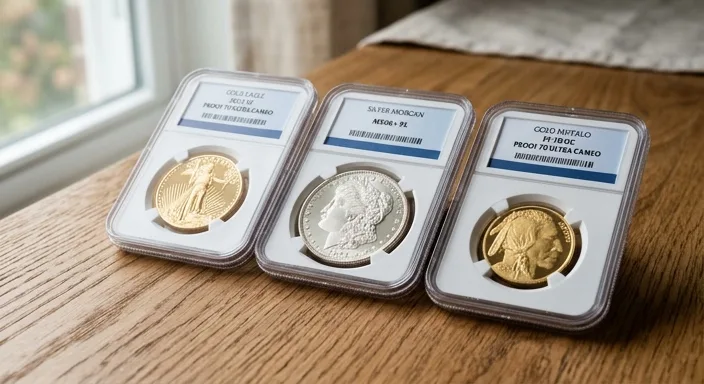
For a beginner, the most dangerous thing you can do is buy "raw" (ungraded) coins from an unverified source. Professional grading services, specifically PCGS and NGC, have revolutionized the market. These companies evaluate the coin, assign it a grade on the 70-point Sheldon scale, and seal it in a tamper-evident plastic "slab."
A certified grade provides "sight-unseen" liquidity. This means you can sell a coin to a dealer or collector across the country because they trust the third-party assessment of its quality. For high-yield collecting, stick exclusively to coins graded MS65 (Mint State 65) or higher, or "Choice" Proof specimens.
Your 5-Step Roadmap to Your First Purchase
Follow these steps to ensure your first foray into numismatics is built on a solid foundation:
- Define Your Niche: Don't try to collect everything. Pick one series—perhaps Pre-1933 $20 Saint-Gaudens Double Eagles or Mercury Dimes—and learn everything about it.
- Analyze Population Reports: Use the free "Pop Reports" on the PCGS or NGC websites. These show how many coins of a certain grade exist. You want to buy coins where the population is low relative to the demand.
- Establish a Budget for Quality: It is always better to own one $1,000 coin that is a "condition rarity" than ten $100 coins that are common. High-yield returns favor the best specimens.
- Verify the "Price Guide" vs. "Auction Results": Price guides are often optimistic. Check recent auction results (Heritage Auctions or Stacks Bowers) to see what people are *actually* paying for the coin today.
- Buy from Reputable Dealers: Only purchase from dealers with a long history and a clear return policy. When buying numismatics, you aren't just buying a coin; you're buying the dealer's reputation.
Common Beginner Traps to Avoid
Trap #1: Cleaning Your Coins. Never, under any circumstances, clean a coin. Even a light rub with a soft cloth can leave "hairlines" that ruin the numismatic value. A dirty, toned coin is worth far more than one that has been polished.
Trap #2: Buying "TV Offer" Coins. If you see coins advertised on late-night television, they are almost certainly overpriced. These companies spend millions on advertising and pass those costs onto you through massive markups.
Trap #3: Overlooking Liquidity. Some coins are rare but have very few buyers. If you buy an obscure foreign coin because it's "rare," you might struggle to find a buyer when it's time to sell. Stick to popular, liquid markets for your high-yield core holdings.
Frequently Asked Questions
Q: What is the minimum I should spend on a numismatic coin?
A: While you can start small, the "high-yield" sweet spot often begins around $300–$500 per coin, where you can find specimens that are genuinely scarce in higher grades.
Q: How do I store my collection?
A: Keep slabbed coins in a cool, dry place. A fireproof safe with silica gel packs to control humidity is ideal. Avoid storing coins in PVC-containing plastics, which can cause chemical damage over time (though slabs protect against this).
Q: Should I buy gold or silver numismatics?
A: Both have merits. Silver (like Morgan Dollars) has a massive collector base, making it very liquid. Gold (like Liberty Heads) offers higher value density and combines the safety of gold bullion with numismatic upside.