I may earn a commission at no extra cost to you. #ad
Free Guide: How to Avoid Overpaying for Gold Bullion in Direct Peer-to-Peer Markets
Jump to Section
- Understanding the Peer-to-Peer Gold Market Landscape
- The Hidden Risks of Direct Gold Bullion Purchases
- How to Calculate "True" Value and Fair Premiums
- Verification Techniques to Protect Your Investment
- Negotiation Strategies for Peer-to-Peer Deals
- Safe Transaction Protocols for Direct Buyers
- Frequently Asked Questions (FAQ)
Understanding the Peer-to-Peer Gold Market Landscape
In recent years, the shift toward direct peer-to-peer (P2P) gold trading has accelerated. Traditional bullion dealers often maintain high overhead costs, which are passed down to the consumer in the form of wide spreads and hefty premiums. Direct markets—such as specialized forums, private local groups, and online marketplaces—offer a way to bypass the "middleman" and trade closer to the actual spot price of gold.
However, the P2P landscape is not regulated like a major exchange. While you can find incredible deals, you are also navigating a space where the burden of due diligence falls entirely on you. Success in these markets requires a mix of technical knowledge, market awareness, and sharp negotiation skills.
The Hidden Risks of Direct Gold Bullion Purchases
Before hunting for deals, one must understand why premiums exist. They often cover the cost of security, authenticity guarantees, and immediate liquidity. When you trade P2P, you are assuming these risks yourself. The most common pitfalls include:
- Counterfeit Bullion: Sophisticated fakes (often tungsten-filled or thick-plated) can deceive the naked eye.
- Premium Creep: Sellers may try to charge "retail" premiums on private sales, negating the benefit of buying P2P.
- Counterparty Risk: The risk that the seller does not deliver the item after payment, or that the meeting environment is unsafe.
How to Calculate "True" Value and Fair Premiums
To avoid overpaying, you must first define what a "fair" price looks like. The price of any gold coin or bar is composed of two parts: the Spot Price and the Premium.
The Spot Price is the current market price for one troy ounce of .999 fine gold on the global exchanges. The Premium is the additional cost that covers the fabrication, shipping, and profit. In a P2P setting, you should never pay the same premium as a major online retailer. If a big-name dealer is selling a 1 oz Gold Eagle at 5% over spot, a P2P transaction should ideally occur at 2% to 3% over spot.
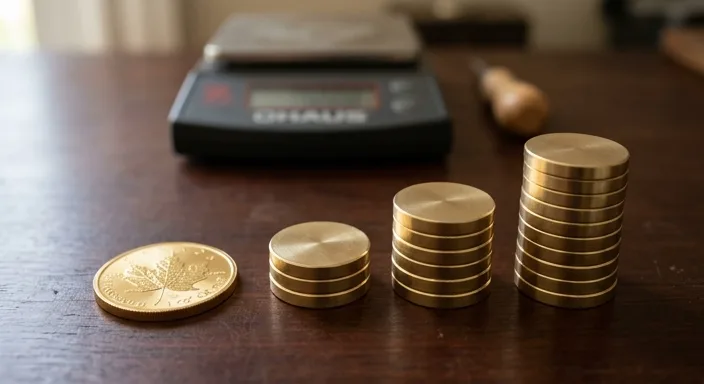
Always use a live price tracking app to know the exact spot price at the moment of the transaction. Markets move fast; a price agreed upon on Monday might be an overpayment by Tuesday morning.
Verification Techniques to Protect Your Investment
You cannot avoid overpaying if you end up buying lead or tungsten. Verification is the ultimate hedge. For P2P trades, follow the "Triple-Check" method:
- Weight and Dimensions: Gold is incredibly dense. Fakes are almost always either the wrong weight or the wrong size (too thick or too wide). Use a digital scale (0.01g accuracy) and digital calipers.
- The Ping Test: Precious metals have a specific resonant frequency. Using an app like 'Bullion Test', you can tap the coin and listen to the ring to verify its metallic composition.
- Electronic Testing: If you are a frequent buyer, a Sigma Metalytics Precious Metal Verifier is worth the investment. It uses electromagnetic waves to see through the coin or bar without damaging it.
Negotiation Strategies for Peer-to-Peer Deals
Negotiation in P2P markets is an art. Many private sellers are motivated by a need for quick cash or a desire to avoid the paperwork and reporting requirements associated with selling to a dealer. Use this to your advantage.
Start by referencing the "buy-back" prices of major dealers. If a dealer would only pay the seller 98% of spot to buy their gold, and you offer 101% of spot, you are offering the seller a better deal while still paying less than the retail "ask" price of 105%. It is a win-win situation that savvy buyers use to keep their costs down.
Safe Transaction Protocols for Direct Buyers
Overpaying can also manifest as "lost capital" through theft or fraud. Never meet a stranger in a private residence. Opt for "Safe Trade Zones" often found at local police stations or busy public lobbies of banks. Banks are ideal because they have high-quality surveillance and you can verify the funds if cash is being withdrawn on the spot.
Avoid high-risk payment methods for shipping deals. If you aren't meeting in person, use platforms that offer buyer protection or trade only with individuals who have a long, documented history of positive "feedback" or "flair" on reputable trading forums.
Frequently Asked Questions (FAQ)
You certainly can, but you will pay a higher premium. P2P markets allow you to capture the "spread" that dealers usually keep for themselves. Over a long investment horizon, saving 2-3% on every purchase significantly increases your total ounces owned.
Generally, yes. Bars have lower manufacturing costs than sovereign coins like Krugerrands or Britannias. However, bars are also easier to counterfeit, so the verification process must be even more rigorous.
Spot is the price for immediate delivery of physical bullion. It is derived from the front-month futures contract on the COMEX or London markets. It is the baseline for all gold pricing worldwide.