Free Guide: How to Securely Buy Bulk Physical Gold Through Direct Marketplaces
Jump to Section
- Understanding Direct Marketplaces vs. Retail Dealers
- Verifying Authenticity in High-Volume Transactions
- Navigating the Logistics of Bulk Gold Shipping
- Negotiating Premium Spreads for Volume Discounts
- Secure Storage Solutions for Large Holdings
- Legal and Tax Considerations for Bulk Buyers
- Frequently Asked Questions
In an era of economic volatility, moving capital into physical gold remains the ultimate "flight to safety." However, there is a vast difference between buying a single gold eagle from a local coin shop and acquiring bulk physical gold through direct marketplaces. When you scale your acquisitions, the risks increase, but so do the opportunities for maximizing your metal-per-dollar ratio.
This guide provides a professional framework for high-net-worth individuals and serious collectors to navigate the world of bulk gold procurement with institutional-grade security and efficiency.
Understanding Direct Marketplaces vs. Retail Dealers
Most casual investors use retail dealers—middlemen who buy from wholesalers and sell to the public at a fixed markup. For bulk buyers, this is often inefficient. Direct marketplaces, or peer-to-peer (P2P) institutional exchanges, allow you to bypass heavy retail overhead.
Direct marketplaces offer transparency. You can see the bid/ask spread in real-time, often narrowing the gap between what you pay and the global spot price. By dealing in "lots" (such as 10oz, 20oz, or kilo bars), you tap into wholesale liquidity. The primary challenge here is the lack of a "corporate" safety net, making your due diligence processes critical.
Verifying Authenticity in High-Volume Transactions
When you are buying gold in bulk, a single counterfeit bar can represent a loss of thousands of dollars. Relying solely on the "look and feel" or even simple acid tests is insufficient for high-volume transactions.
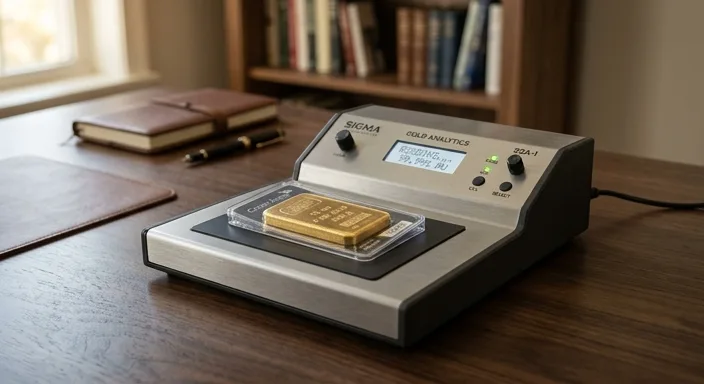
We recommend the Sigma Metalytics suite of products. These devices use electromagnetic waves to penetrate the metal, verifying the core of the bar without removing it from its assay card. For larger kilo bars, ultrasound thickness testing is often employed to ensure there are no tungsten inserts. Always insist on seeing verification footage or third-party assay certificates when purchasing through direct marketplace auctions.
Navigating the Logistics of Bulk Gold Shipping
Moving $50,000 or $500,000 worth of metal requires more than a standard shipping label. Security in transit is the most stressful part of the bulk buying process. Secure marketplaces often facilitate armored transit or registered, insured mail.
- Registered Mail: In the US, USPS Registered Mail is the gold standard for shipments up to $25,000. It is signed for at every handoff and kept in cages.
- Armored Carriers: For quantities exceeding $100,000, services like Brinks or Malca-Amit provide point-to-point security.
- Discreet Packaging: Never use a return address that includes words like "Gold," "Bullion," or "Marketplace." A generic corporate name or personal name is essential to prevent "porch piracy" or internal theft at sorting facilities.
Negotiating Premium Spreads for Volume Discounts
The "Premium" is the amount you pay over the spot price. In bulk markets, premiums are highly negotiable. If you are buying a "monster box" (500 coins) or a collection of 100g bars, you should never pay retail premiums.
Calculate your "All-in Cost per Ounce." If the spot price is $2,000 and the dealer wants $2,100, that is a 5% premium. In the bulk marketplace, your target should be 1.5% to 2.5% for bars and 3% to 4% for government-minted coins. Volume is your leverage; use it to squeeze the spread.
Secure Storage Solutions for Large Holdings
Once you take delivery of bulk gold, the question of storage becomes paramount. Keeping significant wealth in a standard home safe is often a violation of insurance policies and a major security risk.
Consider Third-Party Segregated Storage. Unlike "unallocated" accounts (where the bank owes you gold), "segregated" or "allocated" storage means your specific bars are held in a vault with your name on them. This removes counterparty risk while providing institutional-grade security that includes 24/7 armed guards and massive insurance coverage.
Legal and Tax Considerations for Bulk Buyers
Buying bulk gold involves significant financial movement, which triggers certain regulatory requirements. In many jurisdictions, transactions over $10,000 require a Currency Transaction Report (CTR) or an Anti-Money Laundering (AML) check.
It is a myth that gold is "invisible" wealth. While physical gold offers privacy, the purchase of it through legitimate marketplaces will require KYC (Know Your Customer) documentation. Ensure you keep a meticulous "cost basis" log for every ounce purchased to simplify your capital gains reporting when you eventually decide to liquidate.
Frequently Asked Questions
Is it better to buy many small coins or a few large bars?
Large bars (10oz or 1kg) usually have the lowest premiums, but they are harder to liquidate in small portions. A mix of 1oz coins for liquidity and 10oz bars for cost-efficiency is usually the best bulk strategy.
What is an 'Assay Card'?
It is a tamper-evident package provided by the refinery that certifies the weight and purity of the gold bar. In bulk marketplaces, "In-Assay" gold carries a higher resale value than "Raw" gold.
Can I buy bulk gold with my IRA?
Yes, via a Self-Directed IRA (SDIRA). However, the gold must meet specific purity standards (.995+) and be stored in an approved depository, not at your home.