In the world of rare coin investing, there is a common mantra: "Condition is King." Unlike bullion, where the value is primarily derived from the raw weight of the precious metal, numismatic value is tied to rarity and quality. A single point difference on a grading scale can mean the difference between a coin worth $500 and one worth $5,000.
The rarity of a coin is often defined by its "condition census"—a record of the finest known examples of a particular issue. As coins circulate, they suffer from wear, scratches, and environmental damage. Therefore, finding a 100-year-old coin in pristine, original condition is statistically improbable. Investors pay a massive premium for these survivors because they represent the pinnacle of what is available in the market.
If you are looking to maximize your investment returns, you must understand how to look past the shiny surface of a coin and identify the technical attributes that professional graders value.
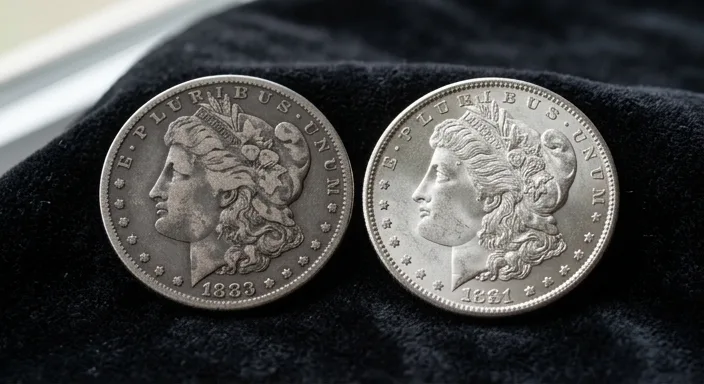
The standard for grading coins is the Sheldon Scale, a 70-point system developed by Dr. William Sheldon in 1949. While originally designed for large cents, it is now the universal language for all US coins.
When professional graders at services like PCGS or NGC evaluate a coin, they look at four primary factors:
1. Surface Preservation: This accounts for "bag marks" (nicks from other coins in a mint bag), scratches, and scuffs. The fewer the marks—especially in the "focal areas" like the face of a portrait—the higher the grade.
2. Strike: This refers to how well the metal filled the dies during production. A "Full Strike" shows every strand of hair or feather clearly, whereas a "Weak Strike" might look worn even if the coin never circulated.
3. Luster: The frost-like sheen created by high-pressure striking. Luster is the "soul" of an uncirculated coin. Once a coin is cleaned or worn, the original mint luster is the first thing to disappear.
4. Eye Appeal: A subjective but critical factor. This includes "toning" (natural oxidation that can turn a coin beautiful shades of blue, red, or gold). A coin with "monster toning" can sell for several times the price of a white coin of the same technical grade.
The most difficult transition for a novice to identify is the jump from AU-58 to MS-60. An AU-58 coin often looks "better" than a lower-end MS coin because it may have fewer marks. However, the presence of even a tiny amount of "friction" or wear on the highest points (like the cheekbone of Liberty or the breast feathers of an eagle) technically disqualifies it from the Mint State category.
To spot this, you need to tilt the coin under a single-source incandescent or LED light. Look for the "cartwheel effect"—the way light rotates around the coin. If the cartwheel breaks at the high points, you are looking at wear.
Because grading is subjective, the market relies on Third-Party Grading (TPG) services. PCGS (Professional Coin Grading Service) and NGC (Numismatic Guaranty Company) are the "Big Two." Coins "slabbed" in their tamper-evident holders are much easier to sell and trade because the grade is guaranteed by experts.
For an investor, buying "raw" (unprotected/ungraded) coins is high-risk. Unless you are an expert, you may inadvertently buy a coin that has been "doctored" or "cleaned," significantly lowering its resale value.
The fastest way to destroy the value of a rare coin is to clean it. Scrubbing a coin with cloth or using chemical dips leaves microscopic hairlines on the surface. To a professional, a cleaned coin is "damaged," and it will receive a "Details" grade rather than a numeric grade, often losing 50% to 90% of its potential value.
Additionally, watch out for PVC damage (green residue from soft plastic flips) and "environmental damage" from moisture. Proper storage in PVC-free holders is essential for maintaining your investment's condition over decades.
While all factors matter, surface preservation and luster are generally the most critical for Mint State coins, whereas the amount of remaining detail (strike/wear) is most important for circulated coins.
Physically, no, unless it is damaged. However, grading standards can evolve, and a coin graded 20 years ago might be viewed differently today. This is why some investors look for "old green holders" (OGH) from PCGS.
For modern bullion (like Silver Eagles), MS-70 is common. For vintage coins (pre-1933 gold or Morgan Dollars), an MS-70 is virtually non-existent because of the way coins were handled and stored at the mint in the 19th century.
Only if the value increase justifies the cost of grading (usually $30-$60 per coin). If a coin is worth $20 in MS-63 and $500 in MS-65, and you believe yours is an MS-65, it is worth the investment.
Professional Jeweler's Loupe
View on AmazonOfficial Guide to Coin Grading and Counterfeit Detection
View on AmazonShare this guide:
If you found this guide helpful, consider leaving a tip!